Puppy weight chart: how to tell if your puppy is growing well
How often to weigh your puppy, what a healthy growth curve looks like for small, medium and large breeds, and the signs that should send you to the vet.
Updated on November 18, 2026 · 4 min read
A puppy changes almost from one day to the next, and it is hard to judge by eye whether they are growing as they should. Your best ally is the scale: a weight noted regularly tells you far more than a single number. Here is how to follow your puppy's growth, what a normal curve looks like, and when to ask for help.
Why track your puppy's weight?
In a growing animal, weight is the simplest health indicator there is. A puppy who gains steadily is usually a puppy who eats enough, digests well and is not fighting an illness or a heavy load of worms.
Regular weigh-ins help you spot two opposite problems: growth that stalls, and growth that goes too fast, which matters a great deal in large breeds. They are also useful to your vet, who works out the dose of dewormers and most medicines from your puppy's current weight.
One warning before going further: a young puppy who refuses to eat, vomits repeatedly, has diarrhoea or seems listless needs to see a vet the same day. Puppies dehydrate and weaken very quickly.
How and how often to weigh
Once a week is the right pace until about 6 months. After that, every two to four weeks is enough until your dog reaches their adult size.
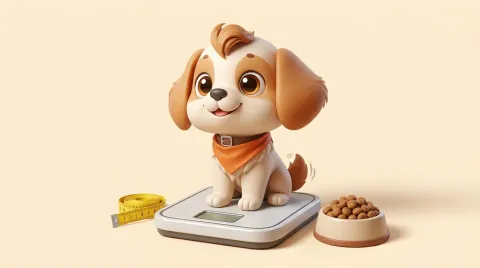
- Small puppies: a kitchen scale with a bowl or a box on top works well for the first few kilos.
- Later on: step on the bathroom scale holding your puppy, then subtract your own weight.
- Big puppies: use the walk-on scale at your vet's. Most clinics are happy for you to drop in just for that, and it is a good way of making the place familiar.
Always use the same scale, at the same time of day (before a meal, for example), and write the figure down straight away.
What a normal growth curve looks like
Every healthy puppy follows the same pattern: a steep climb in the first months, then a curve that gradually flattens as adult weight approaches. How long it takes depends above all on the adult size.
| Adult size | Adult weight reached at around |
|---|---|
| Small breeds (under 10 kg) | 8 to 12 months |
| Medium breeds (10 to 25 kg) | 12 months |
| Large breeds (25 to 45 kg) | 12 to 18 months |
| Giant breeds (over 45 kg) | 18 to 24 months |
As a rough guide, a small-breed puppy reaches half of their adult weight at around 3 to 4 months, a large or giant-breed puppy closer to 5 months. These are averages: breed, sex and family lines all make a difference.
What matters most is the regularity of the curve. Vets use growth charts drawn up by adult size, much like the ones in a child's health record: a puppy should roughly follow their own line. A curve that suddenly bends upwards or downwards is the real signal, far more than a comparison with the neighbour's puppy. For a crossbreed whose adult weight is unknown, your vet can help you estimate it.
Large breeds: more each week, for much longer
A large-breed puppy gains far more weight each week than a small one: a giant-breed puppy can put on more than a kilo a week at the peak. But their growth is also spread over a much longer period, and their skeleton keeps developing well after their first birthday.
This is why they need a food designed for large-breed puppies, with controlled energy and calcium levels, and why they stay on puppy food for longer. Your vet will tell you when to switch to an adult diet.
Faster is not better
Feeding a puppy more does not make a bigger adult: final size is largely written in their genes. It only gets them there faster, on a skeleton that is not ready. Excess weight and over-rapid growth increase the risk of bone and joint problems such as hip or elbow dysplasia, especially in large and giant breeds.
A few simple rules:
- weigh the daily ration instead of guessing, starting from the feeding guide for your puppy's age and expected adult weight;
- do not add calcium or vitamin supplements to a complete puppy food unless your vet prescribes them: too much calcium harms a growing skeleton;
- count treats as part of the ration;
- check their shape: you should feel the ribs easily under a thin layer of flesh and see a waist from above. A growing puppy should be lean, not round.
When to worry
Call your vet if:
- your young puppy has not gained weight over two weekly weigh-ins in a row, or has lost weight;
- the curve suddenly leaves its usual track, upwards or downwards;
- the belly is round and swollen while the rest of the body is thin (often a sign of worms);
- your puppy limps, seems stiff, is reluctant to play or has swollen joints;
- they are much smaller than their littermates, or have a dull coat and little energy.
Most of the time the answer is simple: a deworming treatment, a ration to adjust, a more suitable food. But the earlier a problem is caught, the easier it is to correct.
Keep the curve in your pocket
A growth curve is only useful if the numbers are written down somewhere other than on a scrap of paper. In Medika, you log each weigh-in in a few seconds and the app draws your puppy's growth chart, so you can see at a glance whether the line is steady. If you share the record with your family, whoever weighs the puppy can add the figure, and at the next visit your vet sees the whole curve.
This article is for information only and does not replace the advice of a veterinarian. If you have any doubt about your pet's health, consult a professional.