Microchipping your pet: how it works and why it matters
A chip the size of a grain of rice, a 15-digit number and a database: how pet microchips work, what they cannot do and how to keep yours useful.
Updated on November 18, 2026 · 3 min read
A microchip is the most reliable way to prove who your pet is, and often the only thing that brings a lost animal home. Yet many chips turn out to be useless on the day they are needed, for one simple reason: the contact details behind them are out of date. Here is how it works, and what is up to you.
What a microchip is, and what it is not
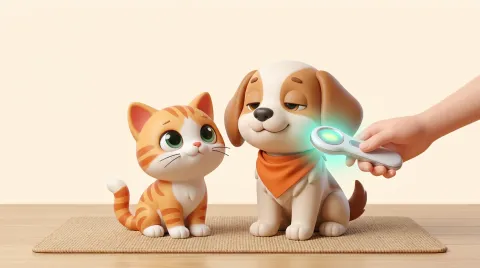
A microchip is a tiny glass capsule, about the size of a grain of rice, placed under the skin. It has no battery and no moving parts: it stays inactive until a scanner is passed over it, then sends back its number. It is designed to last your pet's whole life.
That number has 15 digits and follows an international standard (ISO), so it can be read by scanners all over Europe. The first three digits indicate either the country or the chip's manufacturer.
Two common misunderstandings:
- it is not a GPS. A chip cannot locate your pet. It only helps when someone finds the animal and has it scanned;
- it does not contain your name or address. It only carries a number. Your details are kept in a database, where they are linked to that number.
How it is implanted
The chip is injected under the skin with a sterile needle, on the side of the neck or between the shoulder blades depending on the country. It takes a few seconds and feels much like a vaccination, with a slightly larger needle. No anaesthetic is normally needed, although some owners choose to have it done during neutering.
Depending on the country, it is done by a vet or by another authorised professional. Complications are rare. Occasionally a chip moves a little under the skin or, very rarely, stops responding: ask your vet to scan it at each annual check-up. It only takes a moment.
The step people forget: registration
A chip that is not registered leads nowhere. The number must be linked to your name, address and phone number in the pet identification database of your country. The person who implants the chip usually takes care of the registration, and you receive a confirmation: check that every detail on it is correct.
Then keep it alive. Update the database:
- when you move house;
- when you change phone number;
- when the animal changes owner, including when you adopt an adult pet that is already chipped;
- if you move abroad: ask a vet in your new country how to register the chip there, since databases are national.
Is it mandatory?
In many European countries, microchipping is already compulsory for dogs, and often for cats and ferrets too, usually before a certain age or before the animal is sold or given away. The details vary: your vet knows the rules where you live.
Across the whole EU, a microchip is required to travel with a dog, a cat or a ferret, and it must be implanted before the rabies vaccination for that vaccination to count. (A clearly readable tattoo is only accepted for travel if it dates from before 3 July 2011.)
A European regulation adopted in 2026 will gradually make microchipping and registration compulsory for all dogs and cats in the EU, with long transition periods for pets already living with their owners.
If your pet goes missing
Vets, shelters and pounds have scanners, and so do many local authorities. When a found animal is brought in, it is scanned, the number is looked up, and you get a call, provided your details are current.
If your pet disappears, report it to the database straight away and check that your phone number there is right. A collar with a tag is still worth having, because anyone can read it without a scanner, but collars come off. The chip stays.
This applies to indoor cats too: a window left open, a house move or a trip to the vet is all it takes.
Your pet's chip number, always with you
In Medika, your pet's profile stores the microchip number and its position on the body, next to the passport number and distinctive features. If your pet goes missing, you have the number in your pocket when you call the database, and the app can generate a "lost pet" card from the profile, ready to share on social media or print. One more good habit: write the name of your national database in a note, so you know where to update your details after a move.
This article is for information only and does not replace the advice of a veterinarian. If you have any doubt about your pet's health, consult a professional.